Showing posts with label Investments. Show all posts

Tuesday, August 29, 2017

30 Year Rental Case Study

I wanted to do a review of a property outside of the normal area I look at for rentals, so for this post I have decided to look at potential rentals in Union County, NC. As usual, I am focusing my analysis for rentals on North Carolina, as the property taxes do not change between a primary residence or a rental property. Buy and hold rental investing is definitely possible in South Carolina, you just have to look at each deal individually and see how the numbers work for you.
For this 30 year return analysis, I am looking at a property in Waxhaw. The property is located in the Cureton Community and is currently listed for $300,000. Click here to view the listing (if it is still active).
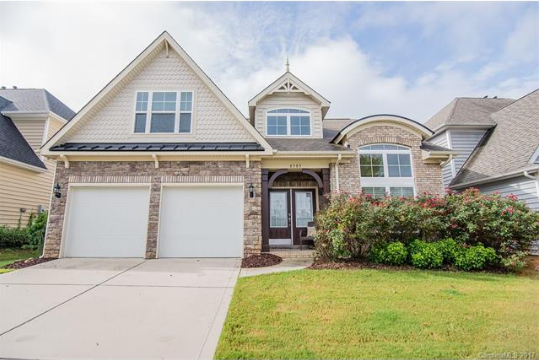
I chose this property because it is less than 10 years old, so should have plenty of life left to it before any major repairs are needed, and a similar floor plan rented recently for $2,095 a month, and this is the basis we will compare this property to.
The Annual Property taxes for this home are $3,120 and annual HOA is $550. I have estimated insurance for this home at $1,200 per year. By putting 20% down with a 5% interest rate on the property, your total payment of Principal, Interest, Tax, and Insurance (PITI) plus HOA comes to $1,694 per month.
With an expected rent around $2,095 per month, this represents $400 of positive cash flow! Not bad for a property that took about 15 minutes to choose, but we need to be a little cautious here. Most investors will want to consider vacancy costs, maintenance costs, and property management. Since this property is fairly new and vacancy in the area is very low, I am going to allot 4% of the monthly rent to each of these items. Property management costs can vary, but I will allocate 10% of the rent to this. By factoring in these items, our monthly income is down to $1,717. Still slightly cash flow positive.
What we need to look at are the future returns of the property, the future value, and overall 30 year return. Since we have used a 30 year mortgage, the home will be owned free and clear at the end of the period, and all other expenses are rolled in so the only investment would be the initial down payment on the home.
One of the great things about this situation is that over the 30 years, the rents will increase while the mortgage payments remain fixed. Taxes and insurance will also increase, and I will calculate those increases relative to the value of the home. Standard rent increases are 3-5% annually, so I will use a 4% increase, and a home appreciation rate of 3% annually.
To put things into perspective, this results in the home being valued at just over $700,000 when it is paid off, with annual expenses of about $40,000 and monthly rent of about $6,500. Over the course of the 30 years of owning the home, a cumulative profit (rental income after expenses plus home equity) of $1,112,310 will be achieved, and using $65,000 as your initial investment ($60,000 down plus closing costs), this represents an annualized rate of return of 9.93%.
Another way to look at this, perhaps you were to purchase a home when your child was born as a college savings plan. After 18 years in this scenario, the cumulative profit would be around $430,000. Who knows what college will cost 18 years from now, but that is a solid foundation to paying for any education!
This analysis is for informational purposes only and is not guaranteed, but if you have any questions about how I came up with these numbers or about how we can make something like this work for you, please don't hesitate to contact me!

Monday, July 24, 2017

Hedge Funds and Single Family Properties

There have been stories of hedge funds and big banks putting pressure on the single family housing market by coming in and purchasing properties for cash to add to rental portfolios. I have heard it from other Realtors, investors, and home buyers alike. The rumor is that by doing this, the institutions have driven up the prices, and once they decide to start selling off these properties, prices will crash. Is this the reality of the situation?
The National Multifamily Housing Council tracks statistics of US households. Some of the statistics they keep are based on owner-occupancy, renter-occupancy, what type units are rented, and ownership of institutional investors, among many other rental statistics.
When we look at 2015, the last year that data is available for, in the United States, there were 118,208,250 households. Of those, 43,701,738 were renter-occupied, which accounts for approximately 37%. Of those renter-occupied units, 15,177,698 of them were single family structures (Homes, Town homes, and Condos, units that are individually deeded and owned, so not multifamily properties).
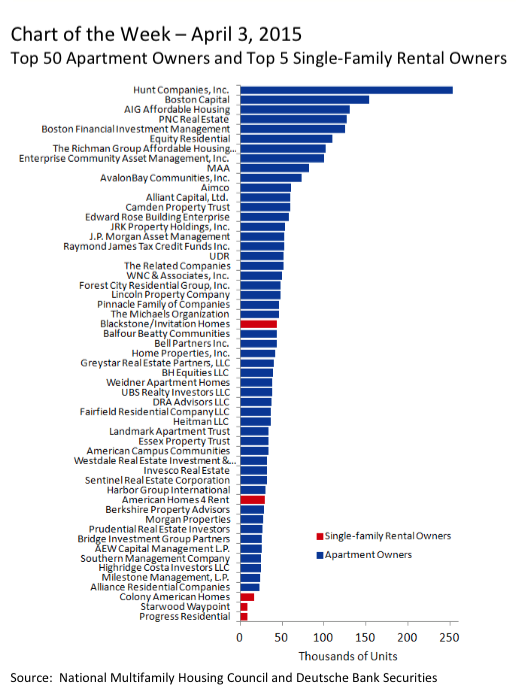
Now when we dig further into Institutional ownership of rental properties, we can see that the largest owners only have multifamily and apartment assets in their portfolios. In fact, only five of the top 50 portfolios are invested in single family units, as shown below.
 
These five largest investors account for approximately 108,000 single family units total. In fact, when we dig deeper, we find that there are a total of only 250 entities that own 250 or more properties, which accounts for approximately 260,000 properties. This is approximately 1.7% of the single family rental properties in the United States.
So that means the vast majority of rental properties are owned by smaller investors in smaller quantities.
Do I think if there were 260,000 additional properties that came to market across the country it might impact prices? Probably to a small extent, but I don't think it would be significant. The chances of them all coming on the market at once is highly unlikely, but even if they all did in the course of a year it would probably stabilize the price point that most of these homes are located in, since as we know the lower price point that investors, first time home buyers, and those looking to downsize, is currently the most competitive for buyers and, at least in Charlotte, has the lowest number of months of supply in history.
As always, if you or someone you know has any questions about our current market, whether to buy, sell, or invest, I am always available to answer those questions. Do not hesitate to contact me!

Monday, May 15, 2017

Debt, Leverage, and Wealth Building

When I Googled "debt" looking for an image to put on this article, it wasn't surprising that I could not find a single one that showed debt in a positive light. Every image was of scissors cutting debt, people being crushed by debt, erasing the word debt, and other similar themes. We have been lead to believe that debt is evil, debt will crush you, and debt will never allow you to grow financially. Has debt become the worst four letter word in the English language? It certainly seems that way.
What do we think of when we hear about debt? Credit card bills, student loans, medical bills, car payments, and mortgage payments for the most part. These are all things we want to pay off as quickly as possible so we can start accumulating wealth, right? In my opinion, not exactly. Not everyone will agree with me here, but that is OK.
Debt can be a great tool to actually helping you build wealth, if it is the right kind of debt. The debt I am talking about is debt that is acquired to invest in income producing and appreciating assets. Of the debt items I listed above, the only one that fits this criteria would be mortgage payments. Certainly credit card debt, student loans, medical bills, and car payments are not going to help you build wealth, those will only take wealth away and should all be avoided to the greatest extent possible.
Good debt allows you to leverage your assets in order to produce greater returns on your investments. Let's take a look at assets and how we can leverage them.
Cash
Cash is not leveraged at all. This is money sitting in the bank making a measly 0.5% interest if you are lucky. Not much to talk about here. It is always good to have some cash on hand though to cover unexpected expenses. If you want to be really safe, have six months worth of expenses in cash or other liquid assets.
Stocks
These can be leverages if you have a margin account. A typical margin account will allow you to trade two times your cash deposit, or if you have over $25,000 and you qualify as a pattern day trader (make more than four round trip transactions per week), they will allow you to trade four times your cash deposit. If we use a hypothetical 6% annual return on your investment, you stand to actually gain 12-24% on your outlay. These are great returns but we should not forget the risk that is involved with the stock market and they will require a great deal of research and time spent managing.
Real Estate - Investor
If you are an investor, banks will let you leverage your money about 5 to 1 (20% down on a mortgage). This means if you purchase an income producing asset, not only are you producing monthly positive cash flow, you are also having a tenant pay down your mortgage, which increases your equity position, as well as your asset most likely appreciating as well. If your property appreciates 5% this translates into a 25% gain on your investment, not including your cash flow and debt payoff. These will typically boost your return another 10-15%.
Can this be true? Let's look at some hypothetical numbers. You purchase a $100,000 house. You put 20% down ($20,000). The house appreciates 5% to $105,000, so your $20,000 investment is now worth $25,000, a 25% increase. On top of that, you earn $200 per month of positive cash flow. This is an additional $2,400 that year, or another 12% of your investment. In this scenario your $20,000 earned you $7,400 in the first year, a total return of 34%. Other than the time spent initially finding the home, this investment is pretty much hands off.
The beauty of it too, the longer you hold the property, the more rents increase, the more equity your tenants pay down (by covering your mortgage payments), and the higher the property will tend to appreciate, statistically speaking.
Real Estate - Home Owner
This is where we can see the greatest gains. As a homeowner, there are currently programs that will allow you to purchase a home for as little as 3% down. That's right, that means you are able to leverage your investment by OVER 30%. In this scenario, what you would typically pay in rent is paying down the cost of your home, and if you think about it you are fixing your rent for a long period of time. Instead of experiencing the typical 5% increase annually in rent, your payment will remain virtually the same for 30 years!
If we consider this scenario with our hypothetical house above where you invest $3,000 to purchase your $100,000 house and it increases in value to $105,000, your initial investment is now worth $8,000. That $5,000 gain on a $3,000 investment is a gain of 167%!! I don't know of any other investment vehicle that will allow you to make gains like that, do you?
For these reasons, it is no surprise that it is estimated that home owners have an average net worth of $225,000 while renters have an average of about $5,000. Home owners are investing using leverage to allow the growth of their assets create exponential growth in their net worth.
I truly wish I could have found an image of a man standing on a mountain of debt to show my opinion of the power of debt and the ability to create great wealth based on a solid foundation of properly used debt.

Monday, May 8, 2017

Paying for College

One thing that is certain is that costs of college education is on the rise. It has been for a while now and is anticipated to continue to do so. Parents should start to consider the burden of this cost when their child is born. Delaying planning for these costs can cause a great deal of stress for both parents and their children. I'm sure no parent wants their child to begin their adult life under a massive pile of debt, but many times that is the case in the society we live in.
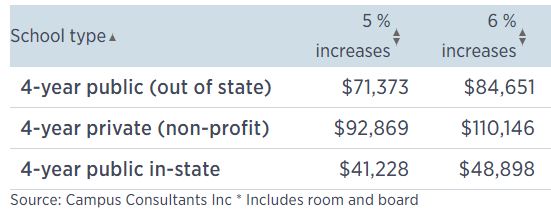
If we look at the anticipated cost of college in 2030 (which is only 13 years away now), expectations are an increase of 5-6% annually. This leads to annual costs for public and private schools as shown here:
 
This means a four year public school degree will cost roughly $200,000, while a private university degree will be pushing $450,000. If those dollar amounts aren't a tough pill to swallow, I envy you.
So how can we help plan for and pay for this education? At the average rate of return of 6% for 529 college savings plans, parents would have to invest $140,000 at the birth of their child in order to afford this $400,000 education. If you choose to invest over a period of 18 years, your contributions will have to be in excess of the $140,000. Again, a tough pill to swallow.
What if there were another way? Well, there is. We can use real estate!
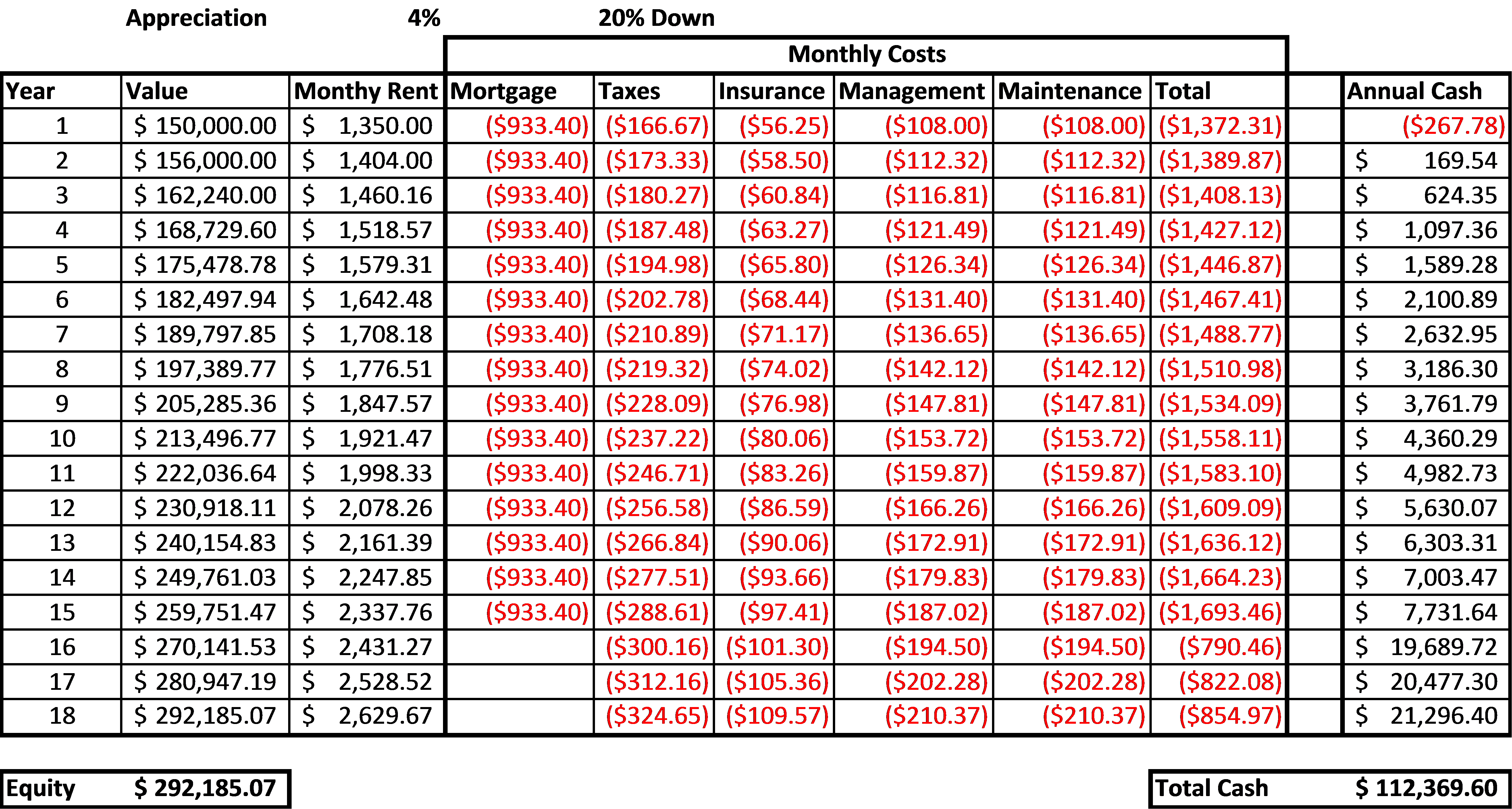
Suppose you were to make an investment in a rental property when your child was born. I know, a new child comes with many new expenses, but bear with me for a minute. We will use a hypothetical $150,000 property, purchased with 20% down with a 15 year mortgage, financed at 4.75% interest. This property will rent for $1,350 per month.
If we run this scenario with the property appreciating at a modest 4% per year (and rents and taxes increase annually at the same rate), here are the numbers for annual property value, rent, expenses, and cash flow.
 
Let your cash accumulate in this scenario. After 15 years, the property is paid off and your cash flow increases dramatically. At the end of our 18 year period, between equity in the property and cash proceeds, you will have accumulated almost $405,000 total. All for the initial investment of $30,000. This represents a 15.5% annual return on your investment, better than you will see from your typical 529 savings plan. The other great thing, is you re-invest your cash returns and pay down the mortgage sooner, your returns will increase further.
So, long story short, having a plan in place for your child's education from the time they are born, you will have the ability to allow them to go to pretty much any school they choose without you or them worrying about the cost. What greater gift can you give your graduating senior 18 years down the road?
If you have any questions about how you can make this happen for you and your family, do not hesitate to reach out to me. I would be more than happy to turn this hypothetical property into your reality!

Monday, April 3, 2017

Southwest Charlotte Rental Analysis

My real estate career began with investing in buy and hold rental properties. To me, the monthly income that is produced by having a rental property is a great way to get into real estate without having to invest a great deal of time, and possibly without having to invest a great deal of money as well.
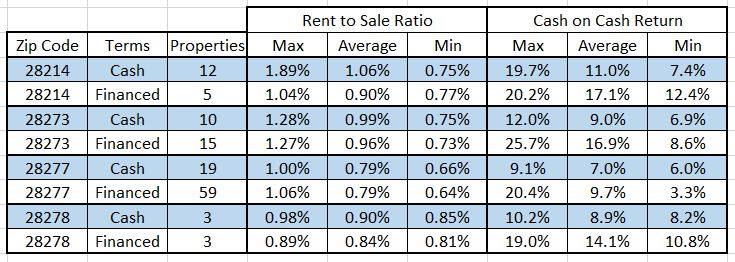
Recently I looked at four zip codes in Southwest Charlotte to see where investors were spending money, how much they were spending, and estimated what kind of returns they were seeing. There is so much data available through the Multiple Listing Service, and I felt sifting and sorting through this data would be important for me to understand our local market, both for myself and my clients. THIS DATA IS ALL ACTUAL CLOSED INFORMATION FROM THE MULTIPLE LISTING SERVICE.
Assumptions
In order to have a fair basis to compare, I normalized purchases that were financed to approximately what interest rates are now even though the rates that individual purchasers were probably different. I needed a way to look at everything on a level surface and that seemed like the most reasonable way to do it. I find that investment mortgages typically run 75 to 100 basis points (0.75% to 1%) higher than personal home loans. With 25% down, you would receive a better rate than with 20% down.
In future posts I will tell what terms I used as well, but for this initial one I used an interest rate of 5% and based the mortgage on a down payment of 25%. Currently, first home loans are running about 4.25%, so adding the 75 basis points, we get to right at 5%.
Other assumptions I made were what insurance would cost. Silmilar to interest rates, these rates will vary from person to person and property to property, but I included my normal figures to provide a starting point.
These calculations do not include vacancy, maintenance, and property management, but also do not include future appreciation or rent increases.
Actuals
I have used actual amounts for property taxes and HOA fees. These items are included in the listings so I could use the actual numbers.
Results
Here is a summary of what has sold in each of the four zip codes I examined. 28273, which has been a hot rental market for some time now, appears to still be a great place for investors looking for monthly cash flow on their investments.
 
I do have a spreadsheet with additional breakdown of each individual property for these zip codes, but posting an image if it would not do justice since it would be impossible to read. If you are curious to see the data, please don't hesitate to email me, tom.oneil@kw.com, and I will certainly pass it along. Also, if you have other Zip codes that I could provide a similar analysis on, please let me know.

Monday, March 20, 2017

Which One Is Better?

One of the things that I hear most often when comparing two rental properties with investors is "this one is cheaper, doesn't that make it a better investment?" While you may be able to purchase a house and fix it up to gain instant equity, when evaluating a rental property this is not always the best scenario for the investor. Lets examine two hypothetical properties to see how this can play out.
When an investor is financing a rental property, one of the key components to their evaluation is what their monthly cash flow will be and what percentage of their investment that cash flow is. If we think about the cash outlay for the two rental options we are discussing here, which one will require more? Obviously it will be the one that requires work to be done.
Property A is a fixer upper. Nothing major, just some cosmetic touch ups. It needs paint, flooring, appliances, and a good cleaning. Those repairs will take a few weeks after closing to get done and will cost around $7,000 for our hypothetical property. This property is listed for $113,000.
Property B is move in ready. It is clean, freshly painted, everything looks great. The only difference from Property A is that this one is listed at $125,000. This house will be ready to rent as soon as you close.
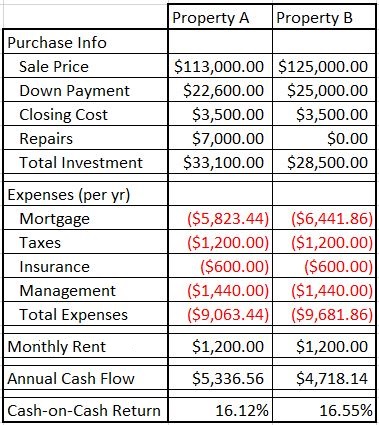
So which one is the better investment? There are two ways to look at it. The easiest way is to say, "Property A. For $120,000 I will be getting a property that is worth $125,000." This is true, and I wouldn't argue with you there, but let's look at it from a cash flow perspective and a cash-on-cash return. We will assume the same interest rate, closing costs, taxes, insurance costs, etc, for each of our two properties. Take a look at the table below:
Cash on Cash Return
The cash flow amount is about $50 a month less for Property B but as you can see in this scenario, the actual return on your investment is slightly better by paying MORE for this home. The reason behind this is because you are using leverage (the bank's money). Another consideration for this first year of investment is that you will likely lose a month's rent for Property A while your repairs take place.
The other great thing about this, as your rents increase over time, the cash-on-cash return of Property B grows faster than that of Property A. This won't always be the case, but it is always important to evaluate the returns of each property, and then even further, the returns of each property based on different down payments (20% vs 25%).
There are some cases where Property A will be a better option, namely if you plan to pay cash and not finance, or plan on purchasing, fixing, and financing after rehabbing (commonly known as the BRRRR Strategy).
If you have any questions about how to calculate these returns, where to find properties like this, or real estate investing in general, please do not hesitate to reach out to me.