Showing posts with label Buying. Show all posts

Tuesday, September 19, 2017

Custom Home Building

When looking for the perfect home, it may be hard to find something in the right location that checks all of the boxes on your "needs" and "wants" lists. For some people, checking all of those "wants" are just as important as the "needs" and they can continue to look indefinitely. This person sounds like an ideal candidate for building a custom home. This process does have some pros and cons, which we will examine here.
When we look at building new homes, there are a couple options that can be explored. Typically the two ways this can work is by going to a new home community and having a home built, or finding a lot in the location you desire, then building a home to suite you on that lot.

New Home Communities
The first is going to a community that is being built and meeting with the onsite representative. They can fill you in to what home plans they have available in that community, and probably even some models that are being built for them to sell off, known commonly as "Spec Homes". They typically will have an onsite model showing many of the options and upgrades that can be had, as well as letting you get a general idea of how they build. Be careful, many of these model homes include upgrades that put them out of the advertised price ranges they show on the main community signs. It is not uncommon for a home with a $350,000 base price to be shown as a model home that would cost you over half million dollars.
There are some advantages to being in a new home community. First, the homes around you will typically be the same style and price range. You don't have to worry about homes being out of line with the remainder of the community. Another advantage is that the community typically offers amenities, such as pools, playgrounds, tennis courts, clubhouse, etc. Finally, normally all of your neighbors will be new to neighborhood as well, so they are great for connecting new owners together.
This style of building does not come without some disadvantages as well. First, these neighborhoods are sometimes known for the homes to be a little cookie-cutter. The builder will probably offer between 4 and 8 floor plans that they will build, meaning you will see some repeating plans in the neighborhood. These homes are not custom, but they will be offered with options that will make them somewhat different and tailored to your taste. Another drawback is in the HOA. The HOA will charge a fee to maintain those amenities we discussed in the advantages, but also it will regulate some aspects of the community. These regulations can range from installation of fences, to what decorations can be placed outside your home, what vehicles can be parked in driveways, or even breeds of pets that you can have. Some people do not like this external interference in their lives.
The timeline to build in a new community can range from 3 - 4 months for some builders, up to 8 - 9 months for others.
Custom Build On Your Lot
Now on to what we would traditionally think of as a custom build. This would be when you find a location you love, but can't find a home. There is a vacant lot that can be had and you buy it! Now you just need someone to put that dream home on it.
Custom building has some distinct advantages over community builds and resales in that you will get exactly what you want. A builder will typically ask you to find a floor plan that you like, and they will work with making some changes to it to fit your ultimate needs and goals. Pricing for these homes can be found all across the board, some builders can build between $70-80 per square foot, while others will start at $150 per square foot, it really just depends what you want (and keep in mind that this does not include the cost of your lot). Another advantage to building custom, depending on what you build and where, it is not uncommon to have some instant equity in your home due to the value of the other homes around you.
Disadvantages hinge right off our last advantage though. Depending on where you build, you will want to ensure that you do stay in line with the community. Building something that doesn't fit with the surroundings will be significantly detrimental to your home's value. Building a 4,500 square foot French Chateau in a neighborhood of 1,200 square foot single wide trailers will not bode well for the value of your home (and unless you are paying for it out of pocket, your lender probably will not approve it). With custom homes, if you buy a lot in a planned community you may find yourself subject to architectural reviews and may still have HOA restrictions.
The time line for building custom is longer than that of a community build, typically ranging from 9-15 months, which does not include 6-8 weeks of pre-planning.
Conclusion
So if you have the luxury of time before having to move on your side and are having trouble finding that property that is what you want in the right location, it may not be a bad option to make it happen on your own!
If you have any questions on finding a lot, looking for a builder, or how to begin the process, know that I am always available to answer these and any other real estate related questions!

Tuesday, August 29, 2017

30 Year Rental Case Study

I wanted to do a review of a property outside of the normal area I look at for rentals, so for this post I have decided to look at potential rentals in Union County, NC. As usual, I am focusing my analysis for rentals on North Carolina, as the property taxes do not change between a primary residence or a rental property. Buy and hold rental investing is definitely possible in South Carolina, you just have to look at each deal individually and see how the numbers work for you.
For this 30 year return analysis, I am looking at a property in Waxhaw. The property is located in the Cureton Community and is currently listed for $300,000. Click here to view the listing (if it is still active).
I chose this property because it is less than 10 years old, so should have plenty of life left to it before any major repairs are needed, and a similar floor plan rented recently for $2,095 a month, and this is the basis we will compare this property to.
The Annual Property taxes for this home are $3,120 and annual HOA is $550. I have estimated insurance for this home at $1,200 per year. By putting 20% down with a 5% interest rate on the property, your total payment of Principal, Interest, Tax, and Insurance (PITI) plus HOA comes to $1,694 per month.
With an expected rent around $2,095 per month, this represents $400 of positive cash flow! Not bad for a property that took about 15 minutes to choose, but we need to be a little cautious here. Most investors will want to consider vacancy costs, maintenance costs, and property management. Since this property is fairly new and vacancy in the area is very low, I am going to allot 4% of the monthly rent to each of these items. Property management costs can vary, but I will allocate 10% of the rent to this. By factoring in these items, our monthly income is down to $1,717. Still slightly cash flow positive.
What we need to look at are the future returns of the property, the future value, and overall 30 year return. Since we have used a 30 year mortgage, the home will be owned free and clear at the end of the period, and all other expenses are rolled in so the only investment would be the initial down payment on the home.
One of the great things about this situation is that over the 30 years, the rents will increase while the mortgage payments remain fixed. Taxes and insurance will also increase, and I will calculate those increases relative to the value of the home. Standard rent increases are 3-5% annually, so I will use a 4% increase, and a home appreciation rate of 3% annually.
To put things into perspective, this results in the home being valued at just over $700,000 when it is paid off, with annual expenses of about $40,000 and monthly rent of about $6,500. Over the course of the 30 years of owning the home, a cumulative profit (rental income after expenses plus home equity) of $1,112,310 will be achieved, and using $65,000 as your initial investment ($60,000 down plus closing costs), this represents an annualized rate of return of 9.93%.
Another way to look at this, perhaps you were to purchase a home when your child was born as a college savings plan. After 18 years in this scenario, the cumulative profit would be around $430,000. Who knows what college will cost 18 years from now, but that is a solid foundation to paying for any education!
This analysis is for informational purposes only and is not guaranteed, but if you have any questions about how I came up with these numbers or about how we can make something like this work for you, please don't hesitate to contact me!

Tuesday, August 22, 2017

Talking To Your Lender

When beginning the process of purchasing a home, one of the first steps to take is to get in touch with a lender. Lenders can provide a great deal of information that is very important in the home buying process. They can work with you before you begin your search to make sure you are not out of your price range. There are many different loan programs, each with its own set of rules, ratios, rates, and requirements, and a lender can help see which one works best for you.
When you initially speak with a lender, they are going to ask some financial questions about your savings, income, debts, and expenses to try to get an idea of your current financial situation. Based on that conversation, they will use the numbers you gave them to decide on a loan program that will work for you. These programs are usually either a conventional loan, FHA, VA, or USDA. Among the differences, each program has different requirements for a debt to income ratio and different mortgage insurance options if you have less than 20% to put down.
Some people think they will need to put 20% down on their purchase, but that is simply not the case. There are conventional programs that start as low as 3% down, and USDA financing in rural locations where you can finance 100% of the purchase price! The USDA Website is a great resource for seeing what locations are USDA eligible (more than you would probably think), as well as income maximums to qualify for the program.
After this initial discussion, the lender will give you a pre-qualification that you will use to submit with your offers. With the real estate market being as hot as it is right now, that is why it is important to have this item completed before seeing a home. When there is a lot of competition, there may not be time between viewing the property and that property going under contract to have the conversation with the lender. And in a multiple offer situation, a seller is most likely not going to consider an offer that does not include a pre-qualification.
One thing that buyers have been doing is to get the lender to also go ahead with a pre-approval. A pre-approval is different than a pre-qualification in that it goes beyond just an initial conversation. A pre-approval takes about 24 - 48 hours, but during that process the lender will review your financial documentation to verify it is all turn and correct, and will perform initial underwriting. Pre-approvals provide an advantage in that sellers know that there is a much better chance of the loan not falling through since all the documentation has been reviewed.
One thing to remember is that even though you have these conversations with one lender, you are not bound to use that lender. I always recommend shopping around rates and fees associated with the mortgage, but that can wait until after you have already gotten your new property under contract.
If you have any questions on where to get started, I have a number of great lenders that I work with who can help determine what will work, where you will fit, and get you on your way to home ownership. Do not hesitate to reach out with any questions.

Tuesday, August 1, 2017

First Step To Buying

When beginning your search for a home, it is tough to know where to start. There really isn't a right or a wrong answer either, but you can save yourself some time by speaking with a Realtor at the beginning of the process. Most people start by looking at homes on the internet. This is a great starting point, but many times those online sites have outdated information.
Most people believe their initial contact with a Realtor should be when they call them up to go view a property. Yes, it is good to take that initiative and find some properties, but most Realtors will want to sit down before hand for a couple of reasons.
Meeting with a Realtor at their office is preferred to save both parties time. It is always good for the Realtor to go through, in detail, exactly what you are looking for. This will allow you to go through additional listings that may fit your needs so you can cover more than one individual property in a day.
A second reason they will want to meet is to be able to set expectations for the remainder of the process. Some people don't realize what the entire process entails, from financing options, to inspections, to closing, and it is good to get a sense of what will happen at the outset so there are no surprises. If you don't already have a pre-qualification or a pre-approval in place, the Realtor can set you up with a lender to make sure you aren't looking at anything outside your price range. This saves you from later disappointment if you cannot qualify.
A final reason for meeting prior to showing the property is for safety. Is it really a good idea for two people who have never met to go meet for the first time at a property that they don't know? Most of the time probably, but you can never be too careful. Meeting at an office ahead of this is a good way to make sure everyone is comfortable with each other.
One of the things I like to do, either before or during the first meeting is to go through my Buyer Needs Analysis. Once we have some guidelines of what we are looking for, it can certainly make the process go much smoother from start to finish.
If you or someone you know is interested in purchasing a home, I would love to speak with them and see if there is anything I can do to help!

Tuesday, July 18, 2017

Where Do We Go?

One of the questions I am often asked in the current seller's market, which is a very valid one, is once I sell this home, where do I go next? If it is such a seller's market and by selling this home for top dollar, won't I have to pay top dollar for the next home I buy? That doesn't necessarily have to be the case. Also, I am not advocating selling your home just because you will get top dollar, there has to be additional reasons to sell.
First we should discuss the reasons for selling your home. We find on average, people move homes about every seven years. This is typically due to changes in life or lifestyle, such as getting married, having children, those children growing, job change or promotion, children leaving the home, or just wanting a smaller home or yard to maintain. While you will probably get more on the sale of your home now than you would in other markets, unless you have another reason besides purely financial, I would not recommend selling.
Now we can go into my reasoning why selling now may be ideal for you. If you are up-sizing your home, besides the obvious life change events discussed in the last paragraph, it makes sense to make a move now as opposed to waiting for additional reasons.
First, interest rates are still at historically low levels. By moving now you can acquire a new home with a lower monthly payment than you will be able to if they increase. A rate increase of 1% will decrease your buying power by over 11%.
Additionally, while we are in a seller's market in most price points, the higher you look in price range, the more balanced the market is. I am not going to call it a buyer's market, but it is much closer to a stable market when you begin to look at homes priced over $400,000. This means if you are selling at a $250,000 price point you are not buying into that same seller's market that you are selling in.
Finally, making your move now may make sense simply due to the fact that by waiting, you are prolonging your future mortgage payments. If you wait for a market shift in all segments, that may take two years, five years, ten years, who knows really. by waiting you are just extending how long it will take to pay down that next mortgage, which may just be further into your planned retirement. Mortgage payments are one of the items that most retirees would like to have off their plate before reaching the typical reduced income of that phase of their lives.
If you or someone you know is considering buying or selling a home, please put me in contact with them. I would be grateful for the opportunity to go over this and other information in more detail. As always, I am here for any real estate needs.

Monday, June 19, 2017

Steele Creek May 2017 Update

Steele Creek is an area of Southwest Charlotte that has been one of the hottest real estate markets in the area. I have witnessed 15% increases in price in individual neighborhoods in the past year in some cases. Before we get into the current state of the market for that area, let's go into a little more detail of some of the things this area has to offer. for its residents, which helps us to explain the current conditions.
Transportation
Transportation is one of the main benefits of Steele Creek. Steele Creek is located just outside I-485 between I-85 and I-77 on the Southwest side of Charlotte. It is also a short commute from this area to the Charlotte Douglas International Airport, which is a regional hub for American Airlines.
Entertainment
Steele Creek is also in proximity of some of Charlotte's great entertainment choices. Located in Steele Creek on the border of North and South Carolina is Carowinds Theme Park, which includes a water park as well. Just a short trip up I-485 North from this area is the US National Whitewater Center, which includes whitewater rafting, zip lines, climbing walls, bicycle trails, and much more. Another new addition to Steele Creek is Topgolf, which has put a whole new spin on the traditional driving range.
Shopping
It doesn't matter what you are searching for, you can buy it in Steele Creek. The intersection of South Tryon Street (NC-49) and Steele Creek Road (NC-160) has long been a center for commerce. This intersection has three different shopping centers, including groceries, big box stores, clothing, local dining options, and fast food options. All along South Tryon you will find shopping. One of the newer shopping areas in Steele Creek is in the Berewick area. This area is centered around the Charlotte Premium Outlets and has been building more retail, dining, and grocery stores around this hub. There is also a plan for a 1,400 acre mixed use development called the River District slated to begin soon.
Market Conditions - 28273 Zip Code
The real estate market in Steele Creek is one of the hottest in the area. If you are a Buyer looking to move to this area, you can expect a lot of competition in your search. If you are a Seller, it is a great time to list. Sellers are typically seeing short times on the market, less competing listings, and, in many cases, multiple offers (when a home is priced properly).
Some of the tell-tale indicators of a market are statistics such as months of inventory, list price to close price, and days on market. Let's take a look at these for Steele Creek, in particular the 28273 Zip Code.
Months of Inventory
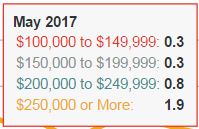
Months of inventory in a market are determined by dividing the number of homes available by the number of homes that close per month on average. A market with six months of inventory is considered stable. Here is what the month of May looked like for Steele Creek:
Months of Inventory
As you can see, there is very low levels of housing supply under $250k. Even above this price point the inventory is still low, but it is not as dire of a situation for available properties. This low inventory will lead us into the next two metrics.
Days on Market
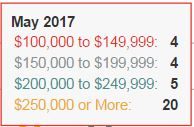
With such a low inventory, it should not come as a surprise that once houses are listed, they are scooped up right away. Looking at the same price ranges for the 28273 Zip Code, we can see that homes are not lasting once listed.
Days on Market
Not a surprise here that the ranges with the lowest inventory have the shortest time on the market.
Percent of List Price
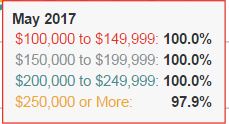
Now that the days on market and low level of inventory are known, it should not come as a surprise that Sellers are having their demands met for the most part when it comes to their asking price.
Percent of List Price
Again, not much of a surprise here. Buyers are having to come to the Seller's demands in these cases. And since these are averages, it is not uncommon for a home to be sold above the actual list price.
Having someone to represent you who understands the current market is of utmost importance in these times. There is a lot of competition out there, you don't want to get left behind.

Monday, June 12, 2017

Interest Rates and Affordability

As a Realtor®, we always hear people talk about what "price range" they are looking in. Obviously sellers will care what they will receive for selling dollar-wise, but our buyers should be more concerned with a monthly payment, which is a function of down payment, term (in years), and interest rate. From a buyer's perspective, until they have talked to a lender, the price range is ultimately irrelevant.
During the pre-qualification or pre-approval process with a lender, it is important for a potential buyer to be honest about what they have to put down, their current economic situation, and what they are comfortable with paying on a monthly basis for the next 15 to 30 years. Just because a buyer is pre-approved for $450,000 does not mean that they accompanying mortgage, taxes, and insurance are a figure they are comfortable with committing on a monthly basis.
Mortgage Rates and Fed Interest Rates
While mortgage rates are not directly tied to the federal reserve interest rates, they do tend to move somewhat close to tandem. Interest rates on mortgages are currently still at historically low levels and it is a great time to lock in a mortgage at one of these low rates.
Mortgage Rates and Home Prices
Some speculate that an increase in mortgage rates will decrease home prices since it will decrease the amount of home some buyers can afford. According to CNBC, increase in interest rates may not decrease prices, but increase due to the other economic indicators that are tied to an increased rate, such as widespread perception of the economy.
Mortgage Rates and Affordability
So back to the initial discussion of monthly payment, as a function of down payment, terms, and interest rate. If we look at the typical 30 year mortgage, with 20% down. If we keep the monthly payment the same and adjust the rate from 4% to 5% APR, how much is our purchasing power decreased?
The answer may be surprising, it was to me.
It is actually OVER 11%!!!
This just means today is a great time to buy. Whether you are a first time buyer, moving up, or moving down, doing so now and locking in a great rate is a very smart move. If you have any questions on the buying or selling process, please do not hesitate to reach out to me. I am always here to help.

Monday, May 22, 2017

Navigating the Current Seller's Market

There is no question that we are currently experiencing a seller's market right now in the Charlotte area. Homes in desirable areas are coming on the market and going under contract with multiple offers in a matter of hours. It is definitely a great time to sell, but if you are selling, where are you going? You are just going to have to buy into that same seller's market, right? Yes, you will, but depending on the price point you are selling at and the price point you are buying in, it may work out to your advantage.

Market Shift?
I have been hearing rumblings that the $350,000 plus market is showing a shift in recent months to actually lean towards a buyer market. While it might be shifting slightly, this isn't quite the case yet. In that range, we are still under six months supply (six months supply is considered a stable market). The key to our current market is that even though the $350,000 plus market is still slightly a sellers market, the $100,000 to $200,000 range and $200,000 to $350,000 range are in a super sellers market, territory that has not been seen in the time for which Charlotte MLS data is available (January 2004 on).

Months Supply
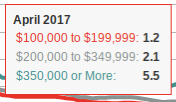
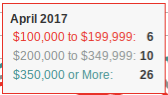
This first image shows the number of months of housing supply there is currently on the market. Months of house supply are determined by dividing the number of homes per sale by the number of homes sold per month.
April 2017 Months Supply
As stated earlier, these are levels not seen before in the period for which data is available. While we have been in a steady decline recently, the previous trough for months supply of the $100,000 to $200,000 range and $200,000 to $350,000 range both occurred in December 2006 and was 3.8 and 4.5 months supply, respectively. We currently have over three times less supply in this lower range!

Percent of Asking Price
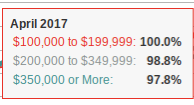
Here we can see the percent of original asking price to sale price. Again, we run into results that have not been seen in the time period for which we have data.
Percent of Original Asking Price
As we can see, the lower priced houses are selling (on average) for 100% of the original asking price. And this is for the entire Charlotte MLS, meaning that some areas are higher, some are lower.

Days On Market
Here are the average number of days on market for for each of the different price ranges. These numbers speak for themselves.
Days on Market

What Does It All Mean?
While it may seem daunting or like a long shot to find a great property to buy in this market, having the right realtor who understands the market and how to create strong offers is of utmost importance. Also, if you are looking to make a move up, this is a great time. While you would not exactly be buying into a buyer's market, moving up provides an excellent opportunity to sell in an extreme seller's market and purchase into one that is quite a bit less competitive.
Also, with the current interest rates, locking one of those in for thirty years at historically rock bottom rates is a great idea.

Tuesday, April 18, 2017

Making a Strong Offer

In today's real estate market, we often find ourselves in situations where homes are coming on the market one day and having multiple offers the next. It is extremely stressful for buyers who need to move in a certain period of time and sometimes buyers think the solution to the problem is to raise the price of their offer. This can create other issues (i.e. appraisal problems), and often times there are other aspects of the offer that sellers will look at when making a decision. Here we will take a look at some of the things sellers will look at when determining the strength of an offer.
Cash Vs Financing
This first one is pretty intuitive, but I figured I would mention it anyway. A cash offer will always entice a buyer more than any financed offer. There is not a third party who needs to approve the purchase. Cash buyers do not require bank approval, which will also include appraisals, inspections, and underwriting. Any of these can cause a deal to fall apart.
Pre-qualification Vs Pre-approval
It is highly recommended that any offer be submitted with some sort documentation proving that you can pay for your purchase. In the case of a financed offer, this would be either a pre-qualification or pre-approval from a bank. Having a pre-approval to accompany your offer is stronger than a pre-qualification. A pre-approval has already gone through preliminary underwriting and the bank has already examined your financial documents as opposed to just taking your word for it.
Also, who your documentation comes from is equally important. A local bank who local market experts have worked with in the past will carry more weight than one from a national bank. The larger banks are notorious for being difficult to get in touch with during the lending process and not closing on time. Agents know this and advise their clients to these issues.
Pre-qualifications and pre-approvals are not binding. The lender may not like it, but you can choose to use a different lender for the actual purchase. Shopping around for the best rate or a lender that works for you is always in your best interest.
Financing Type
The type of financing also comes into play with the strength of your offer. Conventional loans are typically the favored type of financing. These are usually your stronger buyers who are more likely to close. The other drawback of FHA and VA financing is that they have additional inspections and appraisals that can sometimes delay or halt a deal.
Contingencies
When your offer contains a contingency for another event to occur in order for your purchase to go through, this makes it less attractive to the seller. The most common is a financing contingency, which everyone will have unless you pay cash. Another common contingency is the sale of your existing home. This gives first time buyers and investors an advantage over those who currently have a home that needs to be sold. If you do have a home that needs to be sold, talk to your lender and see if it is possible to qualify without that contingency. It may be a stretch to carry financing and make payments on multiple properties, but it may be worth it for a short period if it means getting your dream home.
Timing
Most buyers think that the seller will want to close as fast as possible, however this is not always the case. Sometimes sellers want to delay a closing in order to line up with their next home purchase or maybe even the end of school for their children. If you are flexible as a buyer, it is important that you have your agent contact the listing agent to see if there is a preferred closing for the seller.
So, as you can see, the final purchase price, while important to a seller, may not be the most important aspect of the purchase. Always be sure to align yourself with a Realtor® who can negotiate on your behalf and give you the best chance of creating a win-win situation for you and the other side of the transaction, whether you are a buyer or seller.
If you have any questions about buying, selling, or investing, I am always available to help. Don't hesitate to contact me!