Tuesday, August 29, 2017

30 Year Rental Case Study

I wanted to do a review of a property outside of the normal area I look at for rentals, so for this post I have decided to look at potential rentals in Union County, NC. As usual, I am focusing my analysis for rentals on North Carolina, as the property taxes do not change between a primary residence or a rental property. Buy and hold rental investing is definitely possible in South Carolina, you just have to look at each deal individually and see how the numbers work for you.
For this 30 year return analysis, I am looking at a property in Waxhaw. The property is located in the Cureton Community and is currently listed for $300,000. Click here to view the listing (if it is still active).
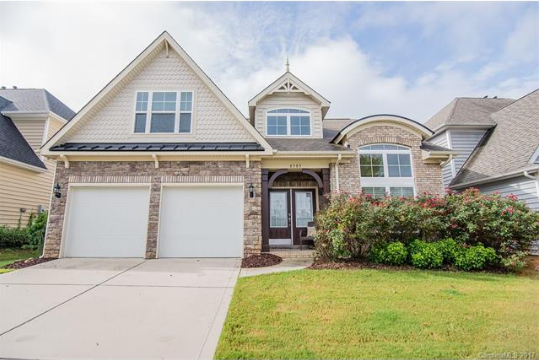
I chose this property because it is less than 10 years old, so should have plenty of life left to it before any major repairs are needed, and a similar floor plan rented recently for $2,095 a month, and this is the basis we will compare this property to.
The Annual Property taxes for this home are $3,120 and annual HOA is $550. I have estimated insurance for this home at $1,200 per year. By putting 20% down with a 5% interest rate on the property, your total payment of Principal, Interest, Tax, and Insurance (PITI) plus HOA comes to $1,694 per month.
With an expected rent around $2,095 per month, this represents $400 of positive cash flow! Not bad for a property that took about 15 minutes to choose, but we need to be a little cautious here. Most investors will want to consider vacancy costs, maintenance costs, and property management. Since this property is fairly new and vacancy in the area is very low, I am going to allot 4% of the monthly rent to each of these items. Property management costs can vary, but I will allocate 10% of the rent to this. By factoring in these items, our monthly income is down to $1,717. Still slightly cash flow positive.
What we need to look at are the future returns of the property, the future value, and overall 30 year return. Since we have used a 30 year mortgage, the home will be owned free and clear at the end of the period, and all other expenses are rolled in so the only investment would be the initial down payment on the home.
One of the great things about this situation is that over the 30 years, the rents will increase while the mortgage payments remain fixed. Taxes and insurance will also increase, and I will calculate those increases relative to the value of the home. Standard rent increases are 3-5% annually, so I will use a 4% increase, and a home appreciation rate of 3% annually.
To put things into perspective, this results in the home being valued at just over $700,000 when it is paid off, with annual expenses of about $40,000 and monthly rent of about $6,500. Over the course of the 30 years of owning the home, a cumulative profit (rental income after expenses plus home equity) of $1,112,310 will be achieved, and using $65,000 as your initial investment ($60,000 down plus closing costs), this represents an annualized rate of return of 9.93%.
Another way to look at this, perhaps you were to purchase a home when your child was born as a college savings plan. After 18 years in this scenario, the cumulative profit would be around $430,000. Who knows what college will cost 18 years from now, but that is a solid foundation to paying for any education!
This analysis is for informational purposes only and is not guaranteed, but if you have any questions about how I came up with these numbers or about how we can make something like this work for you, please don't hesitate to contact me!

Tuesday, August 22, 2017

Talking To Your Lender

When beginning the process of purchasing a home, one of the first steps to take is to get in touch with a lender. Lenders can provide a great deal of information that is very important in the home buying process. They can work with you before you begin your search to make sure you are not out of your price range. There are many different loan programs, each with its own set of rules, ratios, rates, and requirements, and a lender can help see which one works best for you.
When you initially speak with a lender, they are going to ask some financial questions about your savings, income, debts, and expenses to try to get an idea of your current financial situation. Based on that conversation, they will use the numbers you gave them to decide on a loan program that will work for you. These programs are usually either a conventional loan, FHA, VA, or USDA. Among the differences, each program has different requirements for a debt to income ratio and different mortgage insurance options if you have less than 20% to put down.
Some people think they will need to put 20% down on their purchase, but that is simply not the case. There are conventional programs that start as low as 3% down, and USDA financing in rural locations where you can finance 100% of the purchase price! The USDA Website is a great resource for seeing what locations are USDA eligible (more than you would probably think), as well as income maximums to qualify for the program.
After this initial discussion, the lender will give you a pre-qualification that you will use to submit with your offers. With the real estate market being as hot as it is right now, that is why it is important to have this item completed before seeing a home. When there is a lot of competition, there may not be time between viewing the property and that property going under contract to have the conversation with the lender. And in a multiple offer situation, a seller is most likely not going to consider an offer that does not include a pre-qualification.
One thing that buyers have been doing is to get the lender to also go ahead with a pre-approval. A pre-approval is different than a pre-qualification in that it goes beyond just an initial conversation. A pre-approval takes about 24 - 48 hours, but during that process the lender will review your financial documentation to verify it is all turn and correct, and will perform initial underwriting. Pre-approvals provide an advantage in that sellers know that there is a much better chance of the loan not falling through since all the documentation has been reviewed.
One thing to remember is that even though you have these conversations with one lender, you are not bound to use that lender. I always recommend shopping around rates and fees associated with the mortgage, but that can wait until after you have already gotten your new property under contract.
If you have any questions on where to get started, I have a number of great lenders that I work with who can help determine what will work, where you will fit, and get you on your way to home ownership. Do not hesitate to reach out with any questions.

Monday, August 14, 2017

PGA Championship Homes

This past weekend, Charlotte had the privilege of hosting the 99th PGA Championship at the Quail Hollow Club. I was able to attend the event to get a first hand look at the course, some great golfers, and some truly spectacular homes that lined the course. Once I did some digging, I came to find that a few of the homes on the course are actually for sale, although they are just a bit (I wish) out of my budget.
Justin Thomas wrapped up the weekend with the victory, shooting a 3 under par, 68 on Sunday and an overall score for the weekend of 8 under par. Luckily for the players and fans, the weather for the weekend held up pretty well, besides a bit of rain that delayed the action for a little bit on Friday afternoon.
The club was founded in 1959 and sits on 257 acres in South Charlotte. The course itself was originally designed in 1961 by architect George Cobb, but has undergone changes and redesigns over there years, including hole changes by Arnold Palmer in 1986 and a redesign in 1997 by Tom Fazio.
Now on to a few of the homes currently on the market. I apologize to anyone reading this post in the future, as some of these links may be dead if the houses come off the market, but if you are looking for one, I would be more than happy to send you information on what is currently available. You can see the actual listing for each with more pictures and details by clicking the link after each photo.

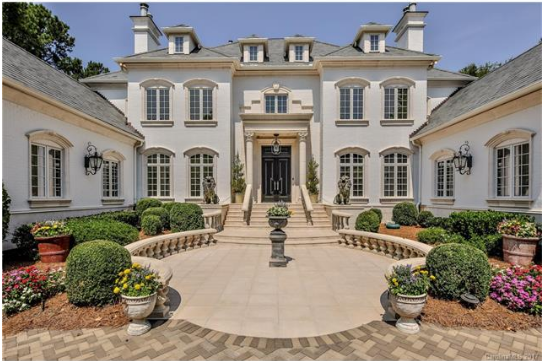
7330 Baltursol
This first home is located on the East side of the course, overlooking the 14th green. The 14th is one of Quail Hollow's signature holes, a drivable Par 4 that is well protected by green side bunkers and a 15 acre lake down the left side of the fairway.
This first home was built in 2007, sitting on just over an acre. The home has 5 bedrooms, 6 full baths, and 3 half baths, coming in at a total size of just under 14,000 sq feet. All of this could be yours for $6.25 Million!

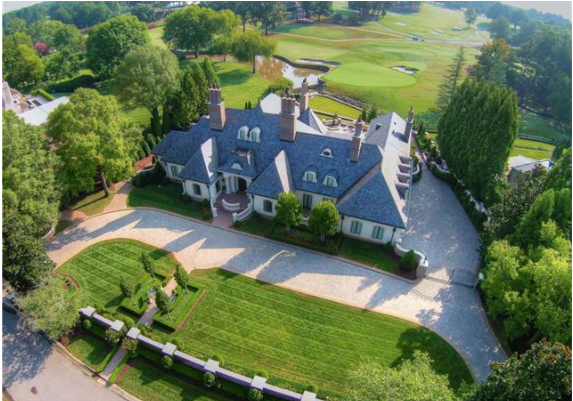
7430 Baltursol
Our next home is also near 14, located just off the fairway. Its covered porch and upper balcony offer great views of the fairway and lake. This home has 5 bedrooms, 5 full, and 2 half bathrooms, at just over 8,000 sq feet. This home is currently listed for $4.25 Million. 

9136 Winged Bourne
The last home is located just off the 7th green, with a fantastic view down the fairway of 7 as well. There is a wide creek / pond running down the fairway and next to the green here. This was probably my favorite hole to see from the course, due to it being set back a little further and viewing it in the backdrop of the action on the course.
This home has 6 bedrooms, 7 full, and 1 half bath and is right at 11,000 sq feet total. The price of this home is also $6.25 Million.
So maybe Quail Hollow is not quite in the price range that can be had today, but there are many other great golf course communities in and around Charlotte. If you would like information on homes on any of these courses, I am more than happy to help!

Tuesday, August 1, 2017

First Step To Buying

When beginning your search for a home, it is tough to know where to start. There really isn't a right or a wrong answer either, but you can save yourself some time by speaking with a Realtor at the beginning of the process. Most people start by looking at homes on the internet. This is a great starting point, but many times those online sites have outdated information.
Most people believe their initial contact with a Realtor should be when they call them up to go view a property. Yes, it is good to take that initiative and find some properties, but most Realtors will want to sit down before hand for a couple of reasons.
Meeting with a Realtor at their office is preferred to save both parties time. It is always good for the Realtor to go through, in detail, exactly what you are looking for. This will allow you to go through additional listings that may fit your needs so you can cover more than one individual property in a day.
A second reason they will want to meet is to be able to set expectations for the remainder of the process. Some people don't realize what the entire process entails, from financing options, to inspections, to closing, and it is good to get a sense of what will happen at the outset so there are no surprises. If you don't already have a pre-qualification or a pre-approval in place, the Realtor can set you up with a lender to make sure you aren't looking at anything outside your price range. This saves you from later disappointment if you cannot qualify.
A final reason for meeting prior to showing the property is for safety. Is it really a good idea for two people who have never met to go meet for the first time at a property that they don't know? Most of the time probably, but you can never be too careful. Meeting at an office ahead of this is a good way to make sure everyone is comfortable with each other.
One of the things I like to do, either before or during the first meeting is to go through my Buyer Needs Analysis. Once we have some guidelines of what we are looking for, it can certainly make the process go much smoother from start to finish.
If you or someone you know is interested in purchasing a home, I would love to speak with them and see if there is anything I can do to help!

Monday, July 24, 2017

Hedge Funds and Single Family Properties

There have been stories of hedge funds and big banks putting pressure on the single family housing market by coming in and purchasing properties for cash to add to rental portfolios. I have heard it from other Realtors, investors, and home buyers alike. The rumor is that by doing this, the institutions have driven up the prices, and once they decide to start selling off these properties, prices will crash. Is this the reality of the situation?
The National Multifamily Housing Council tracks statistics of US households. Some of the statistics they keep are based on owner-occupancy, renter-occupancy, what type units are rented, and ownership of institutional investors, among many other rental statistics.
When we look at 2015, the last year that data is available for, in the United States, there were 118,208,250 households. Of those, 43,701,738 were renter-occupied, which accounts for approximately 37%. Of those renter-occupied units, 15,177,698 of them were single family structures (Homes, Town homes, and Condos, units that are individually deeded and owned, so not multifamily properties).
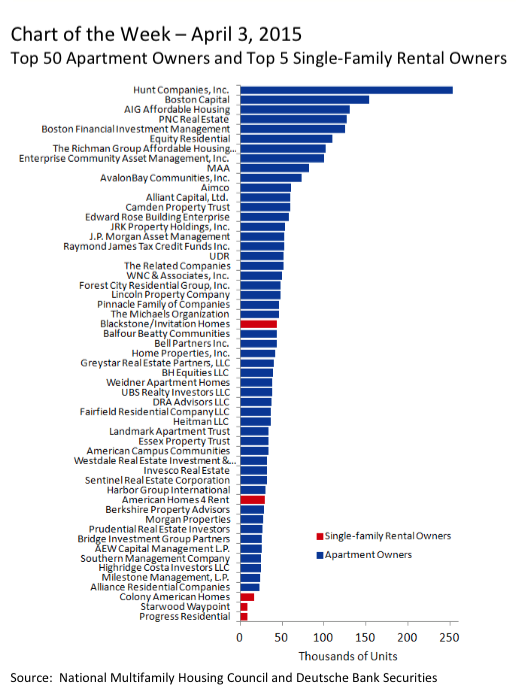
Now when we dig further into Institutional ownership of rental properties, we can see that the largest owners only have multifamily and apartment assets in their portfolios. In fact, only five of the top 50 portfolios are invested in single family units, as shown below.
 
These five largest investors account for approximately 108,000 single family units total. In fact, when we dig deeper, we find that there are a total of only 250 entities that own 250 or more properties, which accounts for approximately 260,000 properties. This is approximately 1.7% of the single family rental properties in the United States.
So that means the vast majority of rental properties are owned by smaller investors in smaller quantities.
Do I think if there were 260,000 additional properties that came to market across the country it might impact prices? Probably to a small extent, but I don't think it would be significant. The chances of them all coming on the market at once is highly unlikely, but even if they all did in the course of a year it would probably stabilize the price point that most of these homes are located in, since as we know the lower price point that investors, first time home buyers, and those looking to downsize, is currently the most competitive for buyers and, at least in Charlotte, has the lowest number of months of supply in history.
As always, if you or someone you know has any questions about our current market, whether to buy, sell, or invest, I am always available to answer those questions. Do not hesitate to contact me!

Tuesday, July 18, 2017

Where Do We Go?

One of the questions I am often asked in the current seller's market, which is a very valid one, is once I sell this home, where do I go next? If it is such a seller's market and by selling this home for top dollar, won't I have to pay top dollar for the next home I buy? That doesn't necessarily have to be the case. Also, I am not advocating selling your home just because you will get top dollar, there has to be additional reasons to sell.
First we should discuss the reasons for selling your home. We find on average, people move homes about every seven years. This is typically due to changes in life or lifestyle, such as getting married, having children, those children growing, job change or promotion, children leaving the home, or just wanting a smaller home or yard to maintain. While you will probably get more on the sale of your home now than you would in other markets, unless you have another reason besides purely financial, I would not recommend selling.
Now we can go into my reasoning why selling now may be ideal for you. If you are up-sizing your home, besides the obvious life change events discussed in the last paragraph, it makes sense to make a move now as opposed to waiting for additional reasons.
First, interest rates are still at historically low levels. By moving now you can acquire a new home with a lower monthly payment than you will be able to if they increase. A rate increase of 1% will decrease your buying power by over 11%.
Additionally, while we are in a seller's market in most price points, the higher you look in price range, the more balanced the market is. I am not going to call it a buyer's market, but it is much closer to a stable market when you begin to look at homes priced over $400,000. This means if you are selling at a $250,000 price point you are not buying into that same seller's market that you are selling in.
Finally, making your move now may make sense simply due to the fact that by waiting, you are prolonging your future mortgage payments. If you wait for a market shift in all segments, that may take two years, five years, ten years, who knows really. by waiting you are just extending how long it will take to pay down that next mortgage, which may just be further into your planned retirement. Mortgage payments are one of the items that most retirees would like to have off their plate before reaching the typical reduced income of that phase of their lives.
If you or someone you know is considering buying or selling a home, please put me in contact with them. I would be grateful for the opportunity to go over this and other information in more detail. As always, I am here for any real estate needs.

Monday, July 3, 2017

Importance of Photography

These days, the cameras on everyone's smart phones are getting better and better. And with this change, everyone seems to think they are a photographer. While this might be the case for your "selfies" and casual photos that you plan to post on Facebook and Instagram, this is not the case for when you are listing your home for sale. Nothing short of a professional photographer who specializes in real estate should be acceptable for your listing photos. If your potential listing agent is not providing such a service, you may want to look elsewhere.
Looking at NAR statistics, we know that 90% of home buyers search online at some point during the process of finding their next property. This online search will typically be your first impression on the potential buyers. You only get one chance to make this impression, so why not put your best foot forward?
A recent report by Inman tells us that 1 in 3 buyers has made an offer without actually seeing the property they are offering on in person. Do you think people are going to be making offers on properties unseen properties with your listing agent taking photos with their iPhone? Unless they have some professional editing software and great add on lenses for their phone, this process is not going to do your home justice in the eyes of potential buyers.
As part of all listings, I have a professional photographer come and capture the true essence of your home. I also bring in a stager for a consultation to make sure that when we do take the photos, your home is ready and looking its best. See more about what sets me apart in the video below.

If you have any questions about listing your home, the process, or anything else about real estate, do not hesitate to contact me.
Also, if you are curious to the value of your home, click here.